
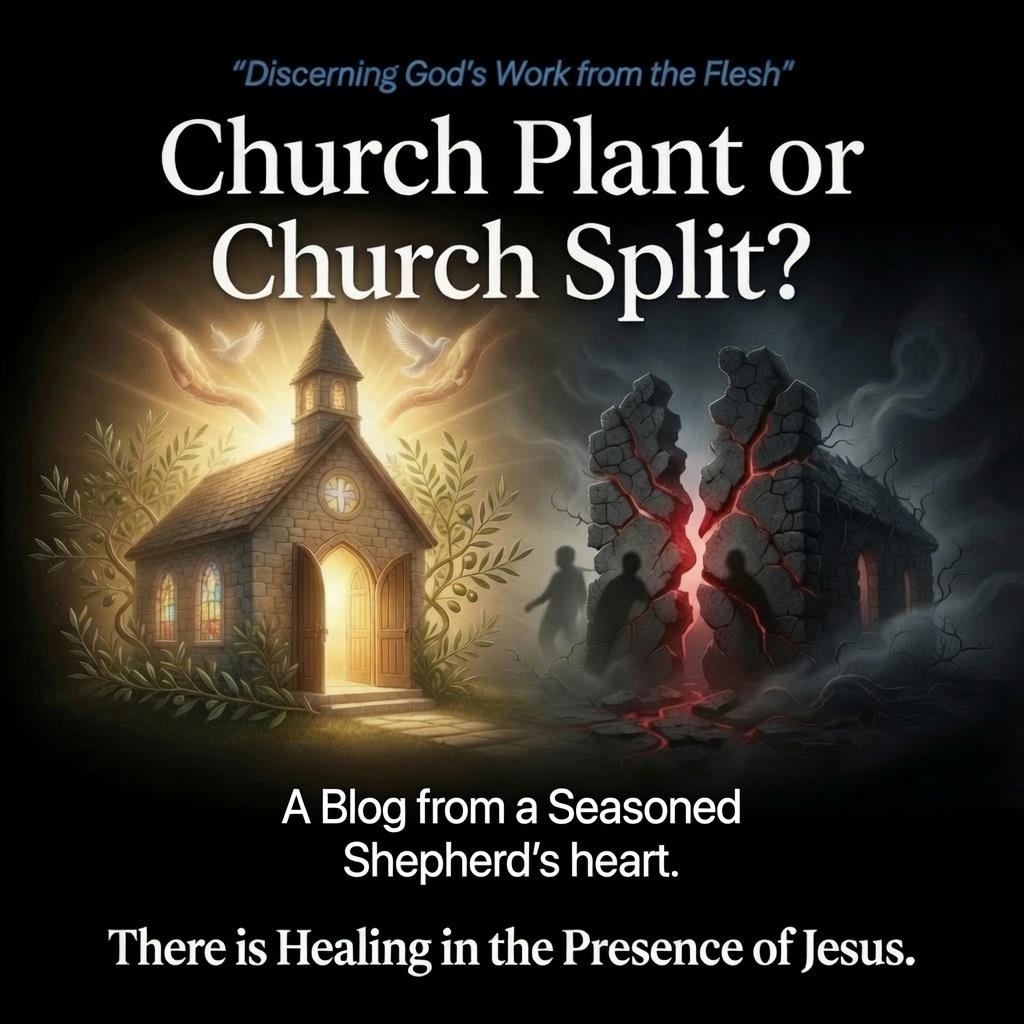
“Discerning God’s Work from the Flesh”
In more than fifty years of ministry and over three decades of pastoring, I have walked through the joy of healthy church plants and the heartache of a handful of church splits. In both seasons I have seen the faithfulness of God and the sufficiency of His grace. Those experiences have taught me that not every new gathering of believers is a move of the Holy Spirit. Some are genuine extensions of the Kingdom. Others are fractures born of the flesh. As Bible students and believers, we must learn to distinguish movements birthed by the Spirit from those driven by human ambition, pride, or deception. One builds the Kingdom; the other tears it down.
The Apostle Paul warned of a “strong delusion” in the last days of people believing the lie because they “received not the love of the truth” (2 Thessalonians 2:9-12). The key question remains simple and searching: Are we being sent by the Spirit and the Church, or are we leaving in discontent?
This blog is not written from a place of anger or pain, it’s coming from a genuine shepherd’s heart who cares for God’s people and wants the best for them. It’s a conversation that is long overdue. I pray peace over you as you read and learn in Jesus’ name.
A genuine church plant is a group of believers intentionally sent out by the Holy Spirit through an existing local church known as the “mother ministry.” It is marked by prayer, fasting, the laying on of hands, and public commissioning. There is blessing, accountability, ongoing relationship, and support from the sending body and from Apostolic Leaders and Networks.
The pattern is clear in Scripture. In Acts 13:2-3 we read:
“As they ministered to the Lord and fasted, the Holy Spirit said, ‘Now separate to Me Barnabas and Saul for the work to which I have called them.’ Then, having fasted and prayed, and laid hands on them, they sent them away.”
Paul reminded Timothy of the same principle: “Do not neglect the gift that is in you, which was given to you by prophecy with the laying on of the hands of the eldership” (1 Timothy 4:14).
The churches Paul planted remained connected, relationally and financially, to the sending work (Philippians 4:15-19). True plants extend the ministry; they do not escape it. They carry the DNA of the sending church while adapting to a new field. The Gospel advanced from Antioch to Ephesus and beyond through appointed elders and shared vision (Acts 14:23; Titus 1:5).
A church split is different in origin and spirit. It is a division in which people, often under the influence of a strong or manipulative personality, become dissatisfied and withdraw to “do their own thing.” It is rooted in pride, comparison, gossip, and the quiet conviction that “we can do it better.” It parallels Satan’s rebellion (Isaiah 14:12-15) and Judas’ betrayal that gets close to leadership then turns on them then denies it.
What begins in good relationship and potential turns through offense, hidden criticism, and eventual open departure. Private complaints spread like leaven (1 Corinthians 5:6-8). Both leaders and followers can be blinded by their own aspirations or unhealed wounds. They claim, “God told me,” or they lean on fleeces and private prophecies that conveniently contradict scriptural order and the unity of the Spirit.
Scripture gives sobering parallels: Judas at the Last Supper, then Satan entering after he left (John 13:27-30); Korah’s rebellion against Moses’ God-appointed authority (Numbers 16); and Diotrephes, who loved preeminence and cast people out of the church (3 John 1:9-10).
Unmanaged dissatisfaction usually breeds disloyalty and betrayal.
Most church splits claim to be church plants. This happens because the enemy works to deceive even the elect in these last days. Some people covet the blessing without being willing to pay the price, so they prey on and try to steal the success of others. As a result, splits usually struggle, while true church plants walk in the blessing.
How can we tell the difference? True plants align with the pattern in Acts. Splits violate the principles of unity and submission.
Signs of a healthy church plant include:
Warning indicators of a church split include:
Proverbs 6:16-19 lists things the Lord hates, and several of them appear repeatedly in splits:
Paul rebuked the Corinthian church for carnal divisions, “I am of Paul… I am of Apollos” (1 Corinthians 1:10-13; 3:3-4).
He urged the Ephesians to walk with all lowliness and gentleness, “endeavoring to keep the unity of the Spirit in the bond of peace” (Ephesians 4:1-6).
Romans 16:17 tells us to mark those who cause divisions and offenses contrary to the doctrine we have learned.
Titus 3:10 instructs us to reject a divisive person after a first and second warning.
Even the call for wives to cultivate a gentle and quiet spirit (1 Peter 3:1-6) stands as a quiet rebuke to any personality, male or female, that stirs discontent and manipulates others.
Test everything by Scripture and by fruit, not by feelings (1 Thessalonians 5:21; Matthew 7:15-20). Pursue reconciliation and humility whenever possible (Matthew 18:15-17). If the Lord is genuinely calling someone to leave a church, let it be done honorably and, if possible, with blessing… never in rebellion.
Leaders must shepherd with gentleness and Godly wisdom. Members must submit to Godly authority while still testing the spirits (Hebrews 13:17; 1 John 4:1). Above all, pray for discernment so that none are swept into delusion.
A true church plant is sent, commissioned, supported, and fruitful. A split is self-initiated, born of discontent and often marked by broken relationships.
Choose the way of the Spirit: humility, unity, and obedience to God’s ordained processes. As the early Church multiplied through sending, may we do the same today for the glory of God.
Acts 13:2-3
Proverbs 6:16-19
Ephesians 4:3
Examine your own heart and your current involvements. Are you building or dividing? Let the Holy Spirit guide you into all truth (John 16:13).
I pray this Biblical teaching helps clear up confusions in God’s Church and promotes unity and healing. This is “sound doctrine.”
If this raises questions about your own leadership posture, You Were Never Meant to Own the People You Lead looks at the same question from a different angle: are you shepherding, or owning?
For more on walking daily in God's presence, grab a free copy of Dr. Vorce's ebook, "Presence Driven."
Much love and prayerful blessings,
Dr. Jonathan Vorce
Get an email when a new post goes live.
No spam, unsubscribe anytime.



Comments
Your name and comment are shown publicly. Please be kind and stay on topic. Comments with links are held for review, and we may remove anything abusive or spammy. Read the comment policy.